

After He'd Gone: The Afterlife of Saroyan's Writings
When William Saroyan’s heartbeat faded on May 18, 1981, he still had millions of unpublished words among his papers: letters, notes, stories, even complete unpublished novels and plays. His passing led many to begin working on projects that used this remaining material, as well as republishing the vast bulk of work that appeared during his lifetime, for new collections. These works often show portions of the life and work of William Saroyan in a new light only available once the master himself was no longer there to tell us what to think of them.
These collections tend to be full of stories that devotees would have known and loved, mixed with lesser-known works added in to give a fuller picture. Nearly all of them include commentary on the man and his lifetime of writing, often from a personal point of view from those who knew him. These works represent an important aspect of Saroyan's career, one in which he is absent as critic of the treatment of his work (and in life he'd had notable battles with those editing his collections), but with a voice that still resonated.
 Births – 1983
Births was written in 1979 at his apartment at 78 rue Taitbout in Paris. The final book published in his lifetime, Obituaries, reached American bookstores as he wrote these pieces in his French flat. Births is a series of ruminations, written daily in the month between June 23rd and July 22nd. The pieces hold together as a single work, though each of them individually feel less like a part of a whole, but as a dawning thought. These are the thoughts of a man in the twilight of his life reflecting back, with a definite nod towards birth, rebirth, and transformation.
The book was published by Creative Arts Book Company of Berkeley, California. It was the first book of his work published after his death that featured unpublished words. It is the first book published with the copyright noted as ‘The William Saroyan Foundation’.
The introduction was written by David Kherdian, who opens his introduction with this:
“Saroyan, the poet of childhood, is dead.
He was my mentor, as I was for him, in our own loose relationship, the only pupil he ever had.”
He talks about Saroyan not only as a legend, but of his timelessness. Kherdian believes Saroyan's writing was the writing of youth. It’s the kind of preface/introduction that Saroyan himself might have written for one of his own collections.
Creative Arts Book Company had published Obituaries as well. They would keep publishing throughout the 1980s and 90s, before folding in the 2010s. They would publish another Saroyan collection just a year later.
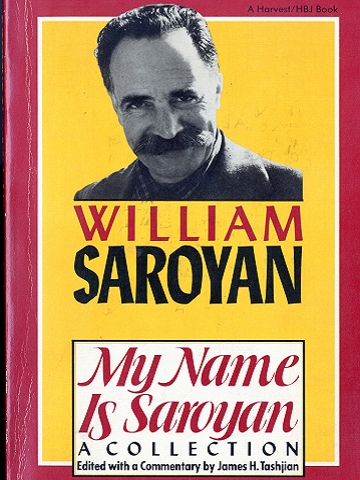 My Name is Saroyan – 1983
Edited by James Tashjian, Saroyan’s friend and founding editor of The Armenian Review, this collection includes stories that first ran in Hairenik Daily, Hairenik Weekly (now The Armenian Weekly), and The Armenian Review. These were largely early works from Saroyan, including a few pieces that would be republished in later collections.
While the stories and poems show Saroyan’s evolution from young writer (sometimes writing as Sirak Goryan) to internationally beloved best-seller, they are greatly helped by the addition of a long preface by Tashjian and a strong set of notes on the stories themselves. Tashjian, who had been with these stories since they were written, provides an incredibly important sense of connection to the works.
Many of these stories were being collected for the first time and represent an important documentation for these works that were only otherwise available in printed periodicals that had become difficult to source by 1983. Also important is Tashjian's commentary, which comes from a place of having worked with Saroyan both before and after he became a superstar in the literary field.
 The New Saroyan Reader – 1984
The sub-title for this massive trove of Saroyan writing is ’A Connoiseur’s Anthology of the Writings of William Saroyan” and it lives up to that billing. Featuring more than 50 stories and novel excerpts from across Saroyan’s career, the book gives an excellent overview of not only the ways in which Saroyan grew as a writer, but how his eye towards the world and writing moved in new directions.
The anthology is sometimes confused with The William Saroyan Reader from 1958, published by George Braziller, and though there are some stories that are included in both, they are distinct volumes. It features some deep cuts, including four stories first published in the Armenian periodical Hairenik, from his short story works, and also several chapters of his memoirs Here Comes, There Goes, You Know Who, Days of Life and Deat and Escape to the Moon, Chance Meetings, and Obituaries.
This was edited by Creative Arts Book Company and edited by Brian Darwent, who wrote a biographical sketch of Saroyan based largely on the authot’s own writings. Darwent would return to Saroyan a decade later, though this was Creative Arts’ last Saroyan work published.
 The Pheasant Hunter – 1986
One of the more innovative publishers of the 1980s was Redpath Press. While they published traditional books, they also sold a line of short stories as greeting cards called Perfect Presents. These were sold in bookstores, often in spinner-racks as impulse buys at the register. They were also purchased by hotels and cruise lines as gifts to leave on the pillows of guests instead of the traditional mint. These small titles, short stories, we printed small, only seven-and-a-half by four inches. Redpath included stories from the likes of Woody Allen, Kurt Vonnegut, John Cheever, and A.A. Milne.
Saroyan’s entry¸ The Pheasant Hunter, originally appeared in his collection The Assyrian in 1950. The handsome slim work was designed by Rita Marshall with beautiful bird illustrations by Etienne Delessert.
While the story is considered one of Saroyan's finest, it had only been re-printed once after its initial appearance in The Assyrian, in an issue of World Review, a UK-based magazine.
 Madness in the Family – 1988
Edited by Leo Hamalian, the former editor of Ararat Magazine who had published Saroyan for a number of years. This was the first new collection of Saroyan’s magazine work since The Whole Voyald in 1956 (though a reprint collection, My Kind of Crazy, Wonderful People was published by Harcourt Brace for a classroom audience). The collection focuses on stories released in the 1970s in magazines such as The Atlantic, The New Yorker, The Ladies’ Home Journey, and Harpers.
It is a tight collection, there is a brief editor’s note, a re-published introduction from Saroyan’s Places Where I’ve Done Time, and then a letter from William Saroyan to James Laughlin, founder of New Directions books. The rest is a collection of 17 stories from an era when Saroyan was publishing stories widely, but was no longer the driving literary force he had been thirty years prior. Still, pieces like Gaston and The Last Word was Love are among Saroyan’s most fascinating and well-honed.
This was not New Directions' last foray into the Saroyan business, nor their first. Saroyan had appeared in New Directions ’37, an anthology including authors like William Carlos Williams, Jean Cocteau, and ee cummings.
 The Man with the Heart in the Highlands & Other Stories – 1989
This collection of sixteen stories that all come from the period between 1936 and 1944 is an excellent document of Saroyan during his superstar era. This includes work that was in little-seen collections, such as Three Times Three. The editors acknowledge Brian Darwent for bringing this work to their attention.
The title story, one of Saroyan's most important as it was the basis for his first play and one of his most re-printed work, actually first appeared in Three Times Three from Conference Press, a publisher which Saroyan had helped found. The other stories included all seem to show Saroyan’s early prose power, perhaps none so well as his classic piece The Mother.
The introduction to the book was written by Herb Caen, a long-time friend of Saroyan’s and famed San Francisco newpaper columnist. The intro reflects on Saroyan as San Francisco legend and bon vivant more than as a writer.
 Saroyan Memoirs – 1994
Brian Darwent again edits Saroyan pieces, though this time non-fiction. He collected stories from various periods of Saroyan’s writing that deal with his interactions with individuals ranging from Marilyn Monroe to Jean Sibelius. These are more personal stories, and they all came from book sources, mostly from later in Saroyan’s career when he had turned largely to autobiography and memoir. Some are portions of chapters of book including Chance Meetings, Sons Come and Go, Mothers Hang in Forever, Places Where I’ve Done Time, and Not Dying. Darwent’s introduction sets them all into the context of a Saroyan who had known everyone and had views on everything under the sun.
While the focus on the individuals is fascinating, some of the chapters are clipped from their original appearances.
 Where the Bones Go – 2002
This is described as Saroyan’s last memoir, having been started in January 1980, and completed less than five months later, roughly a year before his passing on May 18, 1981. The work is slightly disjointed series of short pieces on topics that seem to reflect on his own need to tell the world everything before his then-inevitable passing.
The piece is actually a small selection from the overall manuscript which runs more than 300,000 words. It was edited by Robert Setrakian, then head of the William Saroyan Foundation, and was published by The Press at California State University, Fresno.
It is an interesting look at Saroyan's tendency to create dates as a primary consideration. While some reviewed the work as feeling somewhat disjointed, perhaps because due to the fact that it is such a small portion of a much larger manuscript, it shows what Saroyan was working towards as his life came to an end.
 Essential Saroyan – 2005
Editor William E. Justice compiled a taut collection of stories that represent many of Saroyan absolute classics, including The Daring Young Man on the Flying Trapeze, Seven Thousand Assyrians, Five Ripe Pears, and The Summer of the Beautiful White Horse. Also included are excerpts of books including The Human Comedy, The Adventures of Wesley Jackson, and The Bicycle Rider of Beverly Hills.
This focus on books is one that Saroyan himself would have appreciated, as he was often lookign for ways to get his books included in his anthologies (notably The Saroyan Special and The William Saroyan Reader) and here they do quite a bit of work illuminating the portion of his career from the outbreak of WWII through to the early 1950s.
This is certainly a piece that gives a strong overview of what Saroyan’s writing was at several parts of his career. While no collection could possibly cover his entire oeuvre in a single, liftable volume, this work certainly gives a very strong introduction.
 Young Saroyan: Follow and other Early writings – 2008
Published as a part of Saroyan’s 100th birthday commemoration, this is mostly a book-shaped publication of his 1928 novella Follow, which was first published serially in the Fresno Bee in 2008. This book is an interesting look at the work, as it provides strong background for the work, including portions of letters to Saroyan’s uncle Mehren (also spelled Mihren) that deal with his time in New York, as well as several pieces that document Saroyan’s time and view of the city.
The book was edited by William B. Secrest, librarian for Fresno County Library, and published by The Press at California State University at Fresno, the book includes an introduction by Dickran Kouymijian, Saroyan's friend and the man who cleaned out the legend's Paris apartment after his death.
He Flies Through The Air with the Greatest of Ease – 2008
 Another massive tome covering a large portion of Saroyan’s career, it combines short stories with novels and plays. Highlighting stories from The Daring Young Man on the Flying Trapeze and other stories, Inhald & Exhale, The Trouble with Tigers, and The Whole Voyald, with the novels My Name is Aram and Tracy’s Tiger, and his beloved play The Time of Your Life. Also included are several pieces from both Obituaries, the final book published in his lifetime, and the intended sequel More Obituaries, a complete manuscript of which exists in Saroyan’s papers at Stanford’s Green Library.
The foreword was written by Herb Gold, a compatriot of Saroyan’s from the 1960s onwards, and a fine writer often associated with the Beat generation, though he considered himself more ‘Beat adjacent’ than an actual member of that tribe. His look at Saroyan is more of a personal set of memories of his friends, while editor William Justice provides a more traditional preface to the Saroyan works within.
These works all show not only Saroyan’s genius and legendary output, but the variety of his visions and ability to work in differing forms while still maintaining a sense of singular purpose. His works present us with an idea of a new optimism that would have been largely lost due to the Great Depression, at first, and later World War II and Vietnam. These volumes demonstrate what Saroyanesque writing is in a way that makes it clear the impact the world had on his writing and, perhaps even more so, the impact his writing had on the world.
