

Saroyan in Russia 1976 - Here Begins the Travel Chronicle

Two folders in the William Saroyan papers at Stanford’s Green Library caught my attention. They dealt with a journey Saroyan took from his part-time home in Fresno, out through Los Angeles and London to Helsinki, Leningrad, Moscow, Yerevan, and finally Athens. The folder is one of the most complete documents of any of his travels and is one that is quite different from many of his other trips.
On the first entry of this journal, dated Saturday October 9 1976 at 1:05pm, Saroyan describes his journey:
“I shall be gone for about 44 days from tomorrow, when with Varazdat Samuelian I fly at 9:25am United Air to Los Angeles, and around 11:30am by T.W.A. non-stop over the Pole to London, British Air around 11:30am Monday to Helsinki, overnight, the next early evening to Leningrad,, Astoria Hotel, and two days later to Moscow Metropole Hotel, and a few days later to Yerevan, although it is spelled Erivan in the International Time Table book Shirley Gormley at Gottschalk’s discovered: the roundtrip Fresno to Moscow was paid by American Express card $886.70.”
This is one of the most detailed of all Saroyan’s coverage of his travels, though even this is incomplete. We know his travels, as documented rather cryptically in the travel memorabilia portion of the William Saroyan papers, and he visited several other cities, including Odessa in Ukraine, though he does not mention that here, in the first outline of the trip. Any trip into the Eastern Bloc at the time would have required extensive visas and permitting, so it’s not like he would have not known, but he has chosen the sites that are most important to his image of the trips.
Or, potentially, he simply had a lot on his mind.

He documents his trip to Helsinki in a few simple paragraphs, one of which looks at his time in the Heathrow airport cafeteria (“Now I have had tea (again) and a cold dirty danish”) and then wraps up the brief time at Heathrow with the simple note, “7:40am, London, lock it up again that’s good enough.”
Journals like this are fascinating for a number of reasons. They do a lot of important work for the researcher in that they are in the moment, providing a glimpse of the minutia of their day-to-day. It gives a view of his travels as a travelogue, but also confirms things that he himself, later, would contradict. While he collected artifacts from all his travels, he often interpreted them inaccurately, especially in regards to year and location.
He barely mentions his flight from LA to London, but writes a portion about his time in the airport with Varaz. He also gives us a hint as to his reason for traveling so much; research.
“What’s your name? Aram Garoghlanian, I said, and that was also meant to be instructions for future usage to Varaz, to stop mentioning that I am a writer and giving my name. I told Varaz, I can’t learn anything from people if they know I’m a writer.”
Many have pointed out that Saroyan was a keen observer of human nature, and part of that was clearly his ability to actually be among humans. In America, he was one of the best-known Americans, but abroad, he could be far more anonymous.
His coverage of Helsinki in his journal is somewhat lacking, and honestly, more focused on his time soaking in his hotel room’s bathtub. He very briefly mentions some of the sites he visited, but he actually spends more time talking about his prior visits when he stayed at the Hotel Torni and visited Jean Sibelius in 1935. He is frequently reflecting on his past, and at the age of 70, it’s understandable, but inserting these asides in a travel journal might seem odd unless he was thinking that this could be the basis for another book, or perhaps a chapter in one. There is also a significant amount of writing about money and the cost of rooms at the Intercontinental for him and Varaz. Saroyan’s journals are chock-full of his complaints and fears about money, in both his private journals and published works like Not Dying.
He followed up his time in Finland by crossing into the USSR and Leningrad. Much of his journaling in Leningrad is more poetic than that of his Helsinki coverage.
“What fun; what talk; what laughter; who jokes the best among the peoples of the world? The anonymous Armenians in the streets talking loud enough to be heard all over town: a boat ride up and down the Neva and the aurora a majestic triumph of the people of Russia: so now to wash and drink tea and to get out to more historic and glorious places: the Winter Palace the Hermitage crowded with people where we bought catalogs and cards and souvenirs all just fine.”
In Leningrad, he is a tourist, and the focus on Armenia and Armenians becomes obvious here. He took a trip to the Siege of Leningrad Memorial with Kevork Missakian. He talks of visiting with the ‘Boys from Erivan’ at his hotel and signing autographs for them. He went to get official portraits done Levon Mughchon(an abbreviation for Muggerditihian) and Razmig Davoyan. He even acquired Armenian staples for his pre-flight hotel room meal:
“I have Armenian style loaves of Bahgharahrch bread with cheese and roast lamb cold whenever I may want food.”
It should also be noted that the actual spelling and grammar have been cleaned up for presentation here. For example, the last portion of the above was initially typed “bread with che4ese and loaroast lamb cold whenever I ammay want food.”
The word "Baghgharahrch" is interesting as it doesn't appear to be a regular Armenian bread style. The typical Armenian bread to be found in Russia in the 1970s would have been Matnakash, a pulled bread, though it could also refer to baghaj. The fact he uses the word 'loaves' would make Matnakash more likely, though certainly the spelling is closer to baghaj, but it is possible that he was referring to any number of other Armenian breads, like Choreg.
He clearly made an effort to seek out Armenians in Leningrad:
“Whee how sweet it is to be in Leningrad and with Armenian poets and professors sculptors and painters writers and taxi drivers laborers and friends strangers and readers of books photographs and drunks and all of the other good people”
This is one of the most Saroyanesque sentiments he could possibly write about his appreciation for the Armenian people. It is very much in line with so many of his works where he celebrates the everyman and their delightful times. It’s the basis for many of his stories, not the least of which being The Time of Your Life.
He makes near-hourly updates to the journal while in Leningrad. These cover everything from his eating, sleeping, and bathing habits, to interactions with the staff. He writes very little about Leningrad himself, his pieces tend to be very inward-facing, but he makes one interesting note at 8:10am on Thursday October 14th:
“Well, the sun has peeked out and the Square with the Ferocious Horse is lit up”
 I know little of Leningrad, but even I am aware of Nick on his Horse, officially named “Monument to the All-Russian Emperor Nicholas I” situated on Saint Isaac’s Square. The statue was considered a marvel when it was unveiled in 1859. The statue is over six meters tall, and the ‘ferocious horse’ and rider is supported by only two points of contact, the horse’s rear hooves. This statue would have been a powerful sight at the time as it was still considered one of the defining pieces of public art in Leningrad at the time, and still today in St. Petersburg.
He also relates attempting to find Tchaikovsky’s grave without success. At least somewhat understandable as it is more than an hour’s walk across the city.
Another interesting note on the Leningrad portion of the journal; there is no mention of Varaz Samuelian by name. He concludes his coverage of Leningrad with this:
“2:05pm This is it then for Leningrad and good enough: the jewel of a Byzantine Church being restored was shut tight so we weren’t able to find out anything about it. We had a Tea Lunch very good at a small almost basement establishment with caviar and such: and talk, so then we visited a very busy bookshop where I chose three misc. books, in English, and now we lock up and go. Forthwith."
While we are not certain the ‘we’ in that passage is Varaz, it does seem likely, and Varaz does cover the trip in his book Willie and Varaz, though many things about his account don’t quite jibe with Saroyan’s account at the moment. For the first thing, he says the trip began on September 28th, when Saroyan has not only clearly dated and time-stamped each entry, but the passport stamps and hotel receipts all follow Saroyan’s timeline. He writes the names of those Armenians they visited as Levon Mkrtichian and Razmik Davoian. Levon’s name is accurate as written by Varaz, though Davoyan is the preferred spelling for the poet.
It's also interesting that Saroyan talks about going through the airport and flying to Moscow, while Varaz says they took a train.
Saroyan settled into the National Hotel in Moscow for several days. He had stayed there on other visits to Moscow, and again instantly made contact with the city’s Armenians. Here, there’s another mention of Mughchon, and visiting an Armenian restaurant for Double Tea with Albert Gasparian. Here, Varaz Samuelian’s name returns to the narrative of the trip as well.
Again, Saroyan brings up his previous visits in 1960 (when he stayed at the National Hotel and, as is typical of his journals on his travels, he complains about the 80 dollars a night rate for the room at the National. He had stayed there before, in 1960, and he appears to think at this point, it’s hardly worth the expense. He also first mentions InTourist in this portion of his journal.
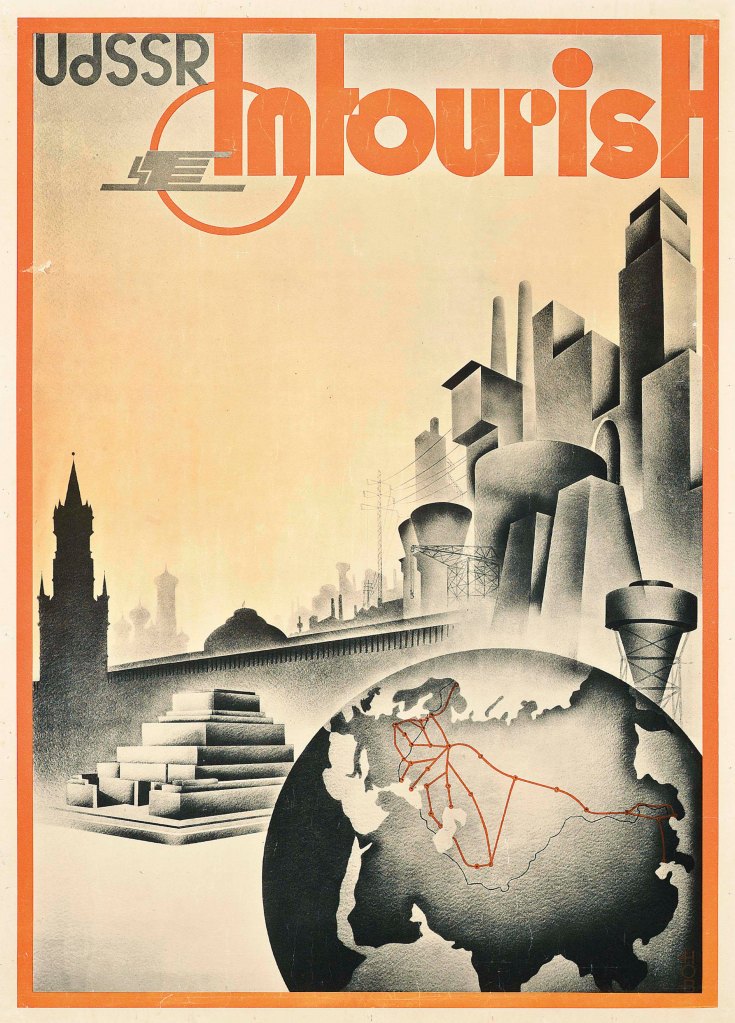 Intourist was the primary travel authority for the Soviet Union from its founding in 1929. It began selling tour packages in the 1950s, and Saroyan took several package tours, and had planned and priced out several others over the course of the 1960s and 70s. His first trip in 1935 had been enabled through Intourist. InTourist was not only a way to allow foreign visitors to experience the USSR, but as a way for the KGB to get a look at foreign visitors and provide them with a positive experience of the Soviet Union. This meant keeping tourists in specific areas to not expose any negative aspects of Soviet life. It was also seen as a way to bring hard currency into the USSR’s coffers to allow it to purchase materials from the West.
During the Moscow portion of the visit, Saroyan sees the finer things the city has to offer. He enjoyed tea lunches almost daily, often with caviar and other fine foods. He is visited by friends who show him the best of the city. He expresses annoyance at the near-constant phone calls from admirers, as well as members of Varaz Samuelian’s large family. Varaz had moved to the Rossiya Hotel, at the time the largest hotel in the world. Less than a year later, there would be a major fire at the Rossiya, killing more than 40 people.
The Moscow portion of the journal ends on October 17 1976, as he prepares to leave for the airport:
“And so here we start pretty much the new chapter of The Travels of The Fall of 1976: The Armenian phase: the least useful was the London phase, because we were required to spend 5 hours in a dreary waiting room: but after that it has been sensible enough, at that: I will proceed now with my packing so that I shall be pretty much ready for the 11 o’clock photograph with Aitmatov both out front here somewhere and at a studio apparently.”
The final dispatch from Moscow is incredibly simple: “10:50am Now I lock it up.”
What is clear from this portion of his journal is that Armenia, and perhaps more accurately Armenians, was the point of this entire trip. Meeting with Armenians all along the way, he only bookended his goal with a necessary buffer to the rest of the world. Travel to Armenia was not easy at the time, but Saroyan’s determination to make the journey and likely to revisit the sites of his previous trips made a longer visit a requirement.
While other extended journals from travel were clearly created with publication in mind, it’s difficult to tell if this was his plan for these pages. While he certainly could have used these entries as material for a new book, it’s also clear that they’re more about recording his seemingly mundane interactions. Still, Saroyan cannot help but write with his expected grace and style. While he clearly wasn’t editing these pages, he was still putting out an incredible amount of effort in his documenting of his travels.
Almost makes one wonder if he had time to actually enjoy any of the sights???
