

Saroyan in Erivan - 1978

Saroyan left Moscow for Erivan on October 12, 1978. In his journal, he noted:
THURSDAY October 12 1978 12:05A.M. Welcome to the day on which I fly to Erivan in my own great immortal Armenia: and to bed, to get ready for that grand event of great joy.
He spent the rest of the morning reading the magazine Soviet Literature, eating, and complaining about the hotel staff. He presumably headed to the airport in the late morning as he notes it was a three-hour flight to Erivan and his first entry to the Armenia Hotel in that fair city was done at 5:05P.M.. He reported that he was warmly received at the airport and that there had been "cameras, both still and film." He also noted that he was joined by "Levon Mughchian (or Muggerditchian) who signed his book for me: full of photographs of my last visit..."
That last visit to Erivan would have been 1976, when he noted that he'd visited the Martiros Sarian Museum and other sights. In Armenia, Saroyan was almost constantly followed by photographers, and in 1976, it is clear that he was followed by at least two different photographers whose photos were turned into books, Mughchian, and Boghos Boghosian whose photos would later be turned into the photobook His Heart in the Highlands.
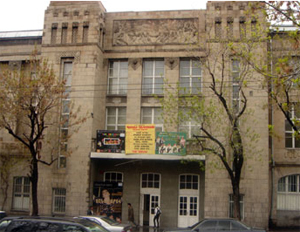 Saroyan was taken by his friend Vahagn Tavtian (Saroyan also wrote it as Tavitian at times) out on to the town, heading to a theatre for an evening of Armenian Dance. Saroyan says that the concert began at 7:30, and along the way, the group planned on stopping at "Tavtian's house for eggs with tomatoes." That could be referring to lolikov dzvadzegh, a typical breakfast and one that Saroyan enjoyed and even made himself at home. The group was supposed to attend the dance concert at The Young People's Theatre, but were caught in a traffic jam, and instead went to Vahagn's house, where his wife, Vartoush, made "a magnificent zuvzegh (perhaps meaning 'Soujoukh (սուջուխ)' a dry spiced sausage) with red peppers for me and chicken and rice and beef and a huge mug of tea."
After the visit, which Saroyan described as a 'grand time', he returned to the hotel, where he enjoyed a bath, and watched some TV, noting at 11:55 p.m. "Just saw the arrival of himself William Saroyan and the embracing of Tavtian, Hamazaspian, and two others I am not sure who they are: Petrossian Matavosian I hope. That permits me now to go and get to sleep."
Saroyan might have frequently clashed with reviewers, but he enjoyed seeing himself mentioned on TV and in print. The sheer amount of clippings he held on to speaks to that truth.
The 13th started with Saroyan finagling a change of room. A creature of habit, he wanted the same room he had been given in 1976, but when his items were transferred to the hotel, he was given a different room. After some back and forth with one of the few employees that spoke good English at the Armenia Hotel, he was safely moved into the room he had wanted from the beginning: Room 504.
Saroyan attended several cultural events over the following days. He went to a six-hour event, the Reception of All Nations, at the Russiya Cinema, and there ran into a photographer from Toronto who had taken photos of him when his cousin Kirk Minasian was visiting him in Paris. The photographer had said that he would mail the photos, but had not, despite Saroyan sending reminders, and he was angry and would not allow him to take photos of him. Even when the photographer would attempt to get pictures of Saroyan from a distance, the author would turn away and purposefully ruin his shot. After the event, he was escorted to an event at President Tadeous Sarkisian's home. There, he was approached by photographers wishing to set up times to shoot with Saroyan. This was a theme of his visits to Armenia, and the reason so many Armenian papers and news agencies have so many photos of his visits.
One thing that Saroyan encountered often on his visits not only to Erivan, but to Moscow and other Eastern Bloc cities was being contacted for help by locals. Varaz Samuelian details this on their trip to Moscow and Erivan in 1976, and Saroyan makes several references to "The Mad Woman of Erivan" in his journal entries. on October 16, he writes:
"I must remember that my bogus relatives, the gimpy lanky man and his swift clever thin wife and their sweet daughter were in the waiting area of this floor this morning but I explained that they must not be dis they must not be encouraged and so the Russian woman who in 1946 came here with her Armenian husband who soon died - she speaks excellent Armenian - asked the people to leave, but when I went down and out to the sidewalk the gimpy man came to me to embrace me as a beloved relative and by God I had to be amused by that and indeed to admire it - they have no relation to me whatsoever but I am going to permit them to continue the pretense..."
He also details a visit from Gegetsik Hovseian, claiming to be a relative of Levon Garoghlanian, and therefore of Saroyan's clan, which is where he took the name of the family from for his book My Name is Aram. Saroyan had met the Garoghlanians on his visit in 1960, though he had not met Gegetsik and assumed he was of no relation.
Saroyan suffered a few bouts of gastric distress, no doubt exacerbated by his well-recorded drinking. He said of a visit with Tavtian, "we split a couple of bottles of vodka and Armenian brandy between us." He also spends significant amounts of time detailing his daily bathroom habits. He did this since his earliest journaling in the 1930s, but became more pronounced as he got older. Much of his final journal from 1981, deals with Saroyan's bowels and their movements or lack-thereof.
He mentions nearly every meal he had, and one that appears over and over is lulu kebab (լուլա քյաբաբ), a skewered meat dish typically made from ground mutton and onion. He had it at least once every day for more than a week according to his journal. He also appeared to enjoy madzoon, yogurt, tea, and lavash several times a day.
Every day, Saroyan toured parts of Erivan and it's outlying areas. He was chauffered about, and on October 21, Zori Balayan's driver, who had taken Saroyan many places, brought him a map with the various places they had visited marked off. This map is currently in the travel documents at Stanford's Green Library.
On October 20th, Saroyan met with Manoog Manatsaganian who brought a TV crew with him. Boghos Boghosian, who had photographed his visit in 1976, again met with Saroyan and shot photos and moving pictures. The next day, he met with Zaven Vartanian, who had met Saroyan's uncle Aram during his visit nine years previous.
 Saroyan attended plays, including Come Let Us Speak Freely by Krikor der Krikorian, and purchased Armenian and Russian magazines and books. This last is interesting because Saroyan did not read either language. He laid praise on Hrant Matevosyan's novel The Orange Herd, which he read in translation. On October 22nd, he visited the Intourist office, and then an art gallery with an exhibition of Hakob Kojoyan paintings. On the 24th, he had a long television interview, as well as visits to well-known Armenian authors and artists. The 26th saw him attend a poetry reading he found rather dour, and a screening of a documentary on Minas Avetisyan, the famed painter who had died just three years prior. After these visits, Saroyan seems to have settled in to try and get some writing done.
But the calls kept coming.
Saroyan notes that he would get so many calls a day that concentrating became nigh-impossible. Calls came from admirers, and even more presumed, or potential, relatives. His hotel was well-known to all from the coverage and almost every day he mentions one visitor or another, almost always uninvited, knocking on his door. All of this, plus his desire to get out and see the good people of Armenia meant that he accomplished little actual writing. He did, however, visit with several officials from the Armenian Writers' Union.
On the 27th of October, Saroyan headed out of Erivan, heading eighty miles south to the city of Vanadzor, checking into the Kirovakan Hotel, where he would continue his visit to his ancestral homeland.
