

Saroyan in Iran: 1972
 William Saroyan was a traveler, and by the 1970s, after decades as a major cultural figure, he began to visit many countries that were new to him, and often these were countries with significant Armenian populations. In 1972, this included visits to countries like India, where he met with the Armenian population of Calcutta, and Lebanon, where he was greeted incredibly warmly in Beirut. After several days in Beirut, Saroyan flew Iran Air to Tehran for his first, and only, visit to the nation.
Tehran's Armenian population is ancient. Since antiquity, there has been a great deal of contact between the Armenians and Persians, and at times the different Persian empires have included parts of, or indeed the entirety, of Historical Armenia. In the 11th century, the Seljuks invaded and drove thousands of Armenians into Persia, where they put down roots, and established churches and schools. A series of treaties and invasions led to the population becoming more and more isolated from other Armenians as that part of the world was carved up by the Ottoman Empire, Russia, and others.
Still, Armenians have been the largest religious minority in Iran for generations, more so even than Assyrians, who come second despite being more traditionally indigenous to the nation.
Saroyan arrived in Tehran in the afternoon of June 30, 1972. His journey had been slightly vexing, as every Armenian he encountered seemed to recognize him and even fewer gave him any personal space. He noted he had to constantly deal with "the usual Armenian interruptions of Beirut, all made by fine fascinating and infuriating people," in his journal. On the flight, he got very sick and vomited throughout the entire flight. This was unusual for Saroyan, who seldom got seasick on weeks-long sea voyages, but he attributed it to 'esophagitis.'
Landing, he grabbed a taxi to the Park Hotel, and finding the hotel to be utterly suitable, he set himself upon the task of relaxing. Saroyan himself said he was never much for rest and relaxation; even his procrastination tended to be focused on non-productive activity. For his first twenty-four hours in Tehran, he did little but work at his typewriter and ignore the annoying ring of his room's telephone. He eventually did take a call from Bishop Karekin Sarkisian of Isfahan. The bishop invited Saroyan for a visit, and he agreed to go in two days' time.
 That seemed to invigorate Saroyan into exploring Tehran properly. He got in contact with a local bishop of the Armenian church: Ardak Manoukian. This was a frequent idea of Saroyan's; if he wanted to see a new city, and there was an Armenian church anywhere in it, he'd contact a cleric and use them to give him entry into the town. Interestingly, in the process of going through the hotel switchboard to contact Bishop Manoukian, the operator introduced herself as Araxie Rostomian, a Persian-born Armenian. He apparently found their brief conversation pleasant enough that they chatted amiably over the rest of the stay at the Park Hotel.
Saroyan was taken around by the Bishop and other church officials, but didn't have a very good time. He seemed to think that they were trying to be 'on' for him, and they didn't have the comedic chops for it. As often happened when he became bored with a forced interaction with people, he started to look down on their roles in society.
"I was hungry and I suddenly had the feeling that while those men are in fact the only glue in the Armenian nation in dispersion, these are also very common ordinary, and even inferior material out of which to do the people any real good and this added to my annoyance"
As usual, Saroyan was in demand from the press, so his guides brought him to the local Armenian paper, Alik. They took many photos, but by this time, Saroyan was starving and irritable. The party headed to The Armenian Club, a restaurant frequented by upper-class Armenians in the city. There, he basically drank water and waited until he could find someone to drive him back to his hotel. An Iranian businessman ended up driving him home, which relieved Saroyan greatly.
He did note that he had been in a funk recently, while he was still splitting his time between Fresno, San Francisco, and Paris. While he had strong social ties to groups in SF and Paris, Fresno was not nearly as open to him, it would seem.
"Let me just be grateful that I am indeed doing all this well, for in Fresno for days on end by the week and month, I have felt virtually unalive from not being involved in anything."
As always seemed to happen, he was besieged with requests for visits and photographs, though this trip he limited them. The next morning he got a call from Jeffrey Lite of the Iranian-American Society asking if he would be willing to attend a reception in his honor. He asked if there was someone from the Society who might take him around, and he said he'd look into it, and no sooner had he hung up than the local Armenian Church contacted him about spending the day with various Church officials. He politely put them off. Saroyan ended up going out for a walk, but quickly turned around to spend the day in his hotel room. He had issues ordering room service, but eventually found himself enjoying delightful madzoon and bread.
Another round of calls came in, including a call from a Miss Janet Lazarian. They had a chat about mutual acquaintances in Erivan and Moscow, and could she come over with a cameraman and then, perhaps, take him to a play, Flying in a Cage by Moussa Mesgarian. This led to a rather strange moment. After having done photographs for the paper that employed Miss Lazarian, and meeting a few other newspaper people, they headed off to the play at The Tehran Youth Palace. They were late, but they did make the curtain call; the play had ended prematurely when one of the young actors had accidentally stabbed the star! Saroyan and Lazarian then headed off to another play, an avant-garde one-act; he did not record the name of the play nor the writer. After the performance, they headed off for a large meal, and finally returned to the Park Hotel, where a dozen messages waited for him, several of which he decided to respond to.
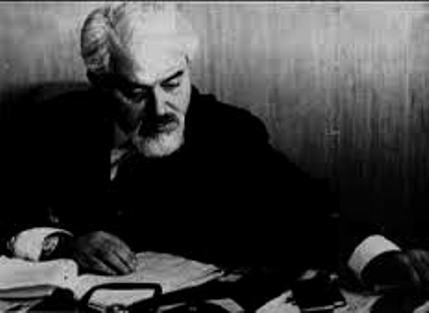 One of them was from Njdeh Aslanian, who invited Saroyan and several others, along to his vineyard. One of those who would be joining them there was Sādeq Chubak, a leading figure in Persian literature.
Before he could get out the door Saroyan "suffered half-a-dozen fools this morning, and one this afternoon."
One of the fools he suffered was a rich man and his family, who dared to ask "why do you not write the story of the Armenian people?" which angered Saroyan greatly.
He visited the winery of Aslanian in a foul mood, though enjoyed meeting with Chubak and various academics who had done their time in the US. He told off the host at one point, but there was a hidden reason for his testiness: a bad tooth.
"The rotten front tooth must come out." Saroyan wrote in his journal, "It has made a fool of me for too long."
He had it pulled by Dr. Eduardo Grigoriantz.
"the full roots or root was removed cleanly and blood came fairly steadily: I signed a copy of Places to him and he refused to let me write a check for his services."
 After a day of rest, and several calls and in-room visits by members of the Armenian clergy and a few others, Saroyan left Tehran for Isfahan, taking a car with Loris Tjeknavorian, composer. The two discussed working together on an opera on the ride to the airport, though it's uncertain whether or not anything came of the discussion. Tjeknavorian would go on to become one of the most important composers of Armenian descent over the next fifty years.
While the modern Armenian populations of Iran settled into Tehran and Tabriz, in the North, there had been a significant Armenian population in Isfahan. He caught a flight, which he managed to make it through without incident. Arriving, he was greeted by the press and a gathering of Armenian-Iranian clergy. That was followed by something that would seem unthinkable in Iran today: an American Independence Day celebration! There, Saroyan met several significant figures in the Iranian government, including Manucher Pirouz, the former governor general. He finally arrived at his hotel, the Shah Abbas, for dinner (he called it 'rotten') and enjoyed a few drinks, partly to dull the pain of his still-aching teeth.

His first day was apparently much better, and he practically gushed about the day: "well there is perhaps no spot in the world sweeter in light and air than Isfahan and I am there: and I have seen and breathed its green and tasted in the nostrils the scent of its flowing town-stream under the beautiful bridge built by Armenians about three hundred years ago: I have visited the Armenian Church full of paintings in frames or on all walls and ceilings: a telling of the stories of the Old and New Testaments: and I have walked among the ten thousand stones in the Armenian Cemetery out by the Athletic Stadium beyond the University: with stones for Christians from all over the world including England and Portugal: and I have been received by His Excellency the Governor General of Isfahan Dr. Gh. R. Kinapour a very gentle and cultured man with a touch of melancholy: to whom I presented a copy of my Human Comedy paperback"
 Isfahan is known for its beauty, and has been for centuries. The Shah Abbas hotel is across the street from the grounds of the Hasht Behesht Palace, considered to be one of the most beautiful urban park areas in all the world.
The stream he refers to is most likely the Zayanderud, quite near the Shah Abbas. The Zayanderud, the largest river in central Iran and often with a strong flow, would have been running somewhat weaker than normal during that period of July, perhaps appearing more like a stream than a mighty river. In the 1980s and 90s, damming of the Zayanderud led to the loss of its permanent flow. In the 1970s, it would have a constant, but variable, flow.
The bridge he refers to is almost certainly the Si-o-se-pol. Built between 1599 and 1602 during the reign of Abbas the Great, the bridge served as a vital link to the Armenian quarter of Isfahan. It's not 100% clear if Armenians did the actual building, though that has been claimed for centuries. It is the largest crossing of the Zayanderud.
The Armenian Church he writes of could be one of several, but the clue of 'full of paintings in frames or on all walls and ceilings' seems to lean us towards Vank Cathedral. The cathedral was begun during the reign of Abbas the Great, and was certainly constructed by Iranian-Armenians over a period of roughly 70 years. Along the walls are paintings that cover the story of Creation, the Expulsion from Eden, and the life of Jesus. At eye level, there are images of the tortures of Armenian martyrs running along the walls. The cathedral is built in a hybrid style, with the main form appearing to fit in with the style of Iranian Mosques, but with elements such as an apse that speak to the Western Cathedral church tradition.
 The cemetery he mentions is the New Julfa Armenian cemetery, which was established in the early 17th century. New Julfa, where thousands of Armenians had been relocated to during the reign of Abbas the Great, is one of the oldest Armenian enclaves in the world. The cemetery is one of the largest Armenian cemeteries in the world, but also has a significant section for Polish refugees who died there waiting to depart to the Persian Gulf to sail to permanent settlements in Africa or New Zealand. An interesting note about New Julfa is that the distinct dialect of Eastern Armenian spoken there for centuries is now spoken regularly in only two places: New Julfa, and in Southern California.
This day of touring would have given Saroyan a strong introduction to Armenian Isfahan, and likely been very tiring, but he continued his tour with stops to meet the administrators of the University of Isfahan, and then to the Prelacy for a massive Armenian lunch. He enjoyed his time with the Bishops here, calling them "lively gentlemen each devoted to the Church." He returned to his hotel clearly reinvigorated for the rest of his trip. He noted that "all is in good order for the reason that I have no rotten tooth in my mouth making me angry."
His visitations continued later. As always, when Saroyan visited cultured people, they would discuss, and sometimes argue, about writing.
"The Governor General likes the writing of a Turk named Aziz Nesin who writes short stories: also Sadaq Hedayat a very depressed writer who committed suicide by gas: also Jamal Zade of long ago: and Ali Ahmad: and Sadeq Choubak (whom I met the other night and of whom I have this odd image: he removed his shirt and revealed a balloon of an upper body then went floating across his green lawn like some kind of swollen animal in some kind of simple exultation a very strange sight): and argued bitterly with his Turkish friend the poet Barahani whose longest poem appears to be in immediate debt to Allen Ginsburgh [sic] which I find unfortunate in itself (as a starting point)"
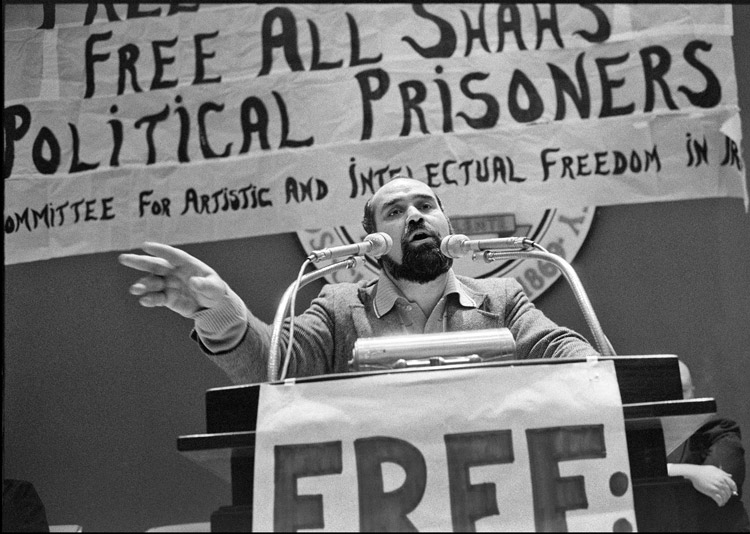 The poet Saroyan argued with was Reza Baraheni, one of the most prominent poets of the time. He was known for his politically charged work of the 1970s, as well as being an acclaimed translator of works into and out of Persian. He would have just released his novel, The Infernal Days of Mr. Ayaz, which was later banned in Iran. Saroyan's reference to the 'immediate debt to Ginsburgh" might refer to the fact that his poems of the time were certainly playing in the same field stylistically as works like Kaddish and Howl. He would soon be jailed and tortured for his writings against the Shah, and would go into exile in the United States afterwards. Allen Ginsberg's writing at the time also bent politically, specifically works like 1971's The CIA Dope Calypso.
The next day, which he said was a "one enormous riproaring day full of all sorts of things." He spoke at a gathering of 300 teachers from Armenian schools across Iran. A lunch was served, which was so filling that Saroyan found himself sick before having to deliver a speech in Armenian and enjoying a performance of local school children. The event was long, and apparently tiring, and continued into a dinner equally as filling as the lunch had been, and which Saroyan chose to skip.
At the event, he met several people who interested him, including a woman from Saroyan's ancestral home, Bitlis, whose 94-year-old father had just passed and may have known his father, Armenak. He seemed particularly impressed with theological student Sherman Fung, married to an Armenian woman with two kids, who was on a mission in Iran.
The next day, he seemed to be heading towards exhaustion again.
"All right, I must get along into this day, but I shall insist on taking it easy, and not letting myself get buffaloed into anything stupid. In short, watch it."
Even with that said, he arranged a trip to Shiraz, a city more than 300 miles away. He was driven by a local Armenian man he met at the earlier events, Hovaness Ohanian. The trip was a six hour drive. Saroyan described the trip as the furthest thing from taking it easy.
"Well it has been one hell of a day one hell of a drive what shall I call it one hell of an exercise in putting up with foolish what absolutely preposterous people from the Bishop to everybody else including the poor thick gentleman Hovaness Ohanian in his broken down Mercedes which lost water every fifteen minutes for the first three hours of travel or so it seemed: any rate it is a miracle"
 He settled in at the Hotel Cyrus Inter-Continental in Shiraz which had been open for less than a year. He had already arranged to fly back to Isfahan, so he wouldn't be forced to endure another day of driving the six hours. He also decided that he would be staying an extra night instead of leaving in the morning. He instructed the switchboard operator to pretend like he had already checked out. He was determined to have a relaxing stay in Shiraz. In fact, he only left the room once the first day, for a walk into the park neighboring the hotel. He spent his time soaking in the bath, writing letters, and apparently journaling. He wrote seven pages of journal entries in his first 24 hours in Shiraz. He also got several newspapers brought up to his room, one of which featured photos of him from the party at the vineyard.
As was often the case when he attempted to order room service in countries where he did not speak the principal language, he had much difficulty ordering at the Hotel Cyprus Inter-Continental.
"A mystifying chat on the phone with three successive non-English-speaking waiters and finally they will come up with a dinner menu from which I will choose something or other for a very nice quiet meal." later he added, "The stupidest room service in the world: everything a big production and all wrong."
The next morning, he apparently lifted his embargo on phone calls and reported that he had several, and later had received several visitors.
He also adjusted his travel plans. He had been scheduled to visit Kabul, Afghanistan, but changed his plans and would fly back to Tehran and then directly on to Calcutta, India. He checked out of his hotel and headed to the Shiraz airport, where he enjoyed a coffee shop meal of pilaf and chicken with tomato.
His final entry on his time in Shiraz was exceptionally Saroyanesque: "And so that's it for Shiraz: the ancient home of poets, roses, wine, nightingales -- and if that isn't a four-way parlay I don't know what is. Good enough. At least I rested here, at any rate. I certainly saw no great man's tomb."
 In a city known for its tombs being the main driver of tourism, perhaps it was harder to avoid them than to visit.
Saroyan's time in Iran in the waning years of the Shah was brief, certainly, but it shows his commitment to being among the Armenian people of the world, of remaining open even when he'd rather close himself off, and of a man who might be cantankerous, but is self-aware enough to admit to it. He would continue his trip to India, and then to Japan, Hong Kong, and finally back to San Francisco. This was the longest and most exhausting trip he took in the 1970s.
